Showing posts with label blog camp goes to mit. Show all posts
Sunday, March 2, 2014
PRAH-leens
I have so many thoughts and so much energy floating around after the TEDx Manhattan yesterday, that I need a few days to process it all and perhaps include some thoughts with my Good Food is Culturally Authentic writing for the Blog Camp Goes to MIT class.
What to do on a Sunday in early March following a snow when it is a balmy 8 degrees outside?
Spring clean
bring out the Easter tree and spring decorations
buy a far too expensive bouquet of tulips
paint your nails bright orange
and, make Pralines
After all it is Fat Tuesday in a couple of days!
Tuesday, November 5, 2013
_____.....It's What's For Dinner
So, might I ask how you filled in that blank?? I know what I was thinking as I wrote it. Did you hear a popular, ingrained slogan in your head when you read it? I can even hear the music from the jingle. Or how about ____...the other white meat? These are just popular catch phrases that emerged as part of our foods industrialization, there is so much to discuss in this can of worms. AND, this is what I am not going to talk about today. In our Blog Camp Goes to MIT course we have been doing some heavy lifting. The topics have been difficult, not so much things that any of us were unaware of, but more so, an in depth dissection of the topics that has left all of us feeling a bit battered. So when Julie suggested a little lighter reading before our next topic, industrialization, which I am leading, I was able to exhale. Just what the doctor ordered, a little reset before we move on.
So literally, what's for dinner?? It is a common question and one that we have to answer daily. Not only is there the cultural side, what are our family rituals associated with eating, but then there is the practical side, what to cook each day while maintaining both yours and your families interest. I can tell you that there have been a couple of very helpful things for the latter. Both Pinterest and Facebook have helped keeping the routine cooking blues away. I am part of two dinner groups on Facebook and daily we ask 'what's for dinner?' Everyone posts their meal plan and then there are a vast number of oohs, ahs, and I never thought of that's, and recipe sharing commences. I know there are a lot of folks out there who get tired of seeing their 'walls' or 'feeds' filled with food, consider this;
"But food is never just something to eat. It is something to find or hunt or cultivate first of all; for most of human history we have spent a much larger portion of our lives worrying about food, and plotting, working, and fighting to obtain it, than we have in any other pursuit."
And
"Food--what is chosen from the possibilities and how much time is allotted to cooking and eating it--is one of the means by which society creates itself and acts out its aims and fantasies. Changing (or unchanging) food choices and presentations are part of every society's tradition and character."
In some cases, food has simply become a means to an end. People will hit the grocery store, purchase something that looks tasty and easy, and never give a second thought to where it came from or how it was produced. Others take one step further and make the conscious effort to utilize the wholesome, healthy advertising on packaged goods in an attempt to make more informed decisions. Still others are even more aware shopping local farm stands, butchers and bakeries for their foods. The one stop shop convenience gone, but more confidence about what is going into your food is worth the extra minutes of traveling. This multiple shop shopping also establishes a ritual to obtaining our food. As an interesting exercise, take notice the next time you are at the grocery store at what is contained in the carts around you. It is very eye opening to the diversity of our food culture.
This summer we moved a huge hutch into the kitchen from our front porch. One of the downsides to our lovely house is a huge lack of storage in the kitchen, the most frustrating being no pantry. This piece of furniture fit perfectly and is now a bursting pantry. With this new availability of space we ramped up our food storage over the summer. We canned masses of produce. What we did not grow ourselves we picked up locally to preserve the taste of summer in these approaching darker months. I then also began to fill the shelves with necessary bulk items, so that I am less likely to run out of things and have staples on hand to make meals without an extra trip. That said, I am not a huge planner in advance. I like to decide what's for dinner based on how I am feeling that day. So, many times I still end up hitting the grocery store daily. There has been a recent study that indicated that those who shop daily tend to eat healthier, though I am not certain how in-depth the study was, it was certainly great justification for my habit.
B and I work together both on the farmstead and in our business, and we take 99% of all of our meals together. With the kids on different school schedules, they each get their breakfast separate, but we are with them in the kitchen chatting about the day...or grunting as my pre-teen may do, she is not much of a morning person and is off to school at 6:30 am. When I introduced our 'linner' last year, it was a big hit and something that the kids look forward to. A good mini meal, that includes a treat. It also aids in reducing complaints at dinner time. Our dinners we eat as a family, we discuss the day and gather around the television to watch some recorded series that we are viewing together. Our first foray into this was watching The Waltons series from beginning to end. Though it may not be ideal to have a meal that is partially plugged in, it is family time that leads to lots of bonding and discussion. Inevitably, when the meal is finished, it leads to each kids snuggling one of us on the couch, which we are enjoying so much right now as those days are surly numbered.
So what's for dinner in our house? Fresh food, consciously prepared with a few mainstays and new ideas added in. It is family time, companionship, learning about what foods we eat and why. It is more than a means to an end, it is enjoying the ritual not only of eating, but gathering ingredients and preparing. So for us--- relationships...it's what's for dinner.
**Above quotes from Much Depends on Dinner by Margaret Visser
Saturday, October 5, 2013
Oh Yes We Are!
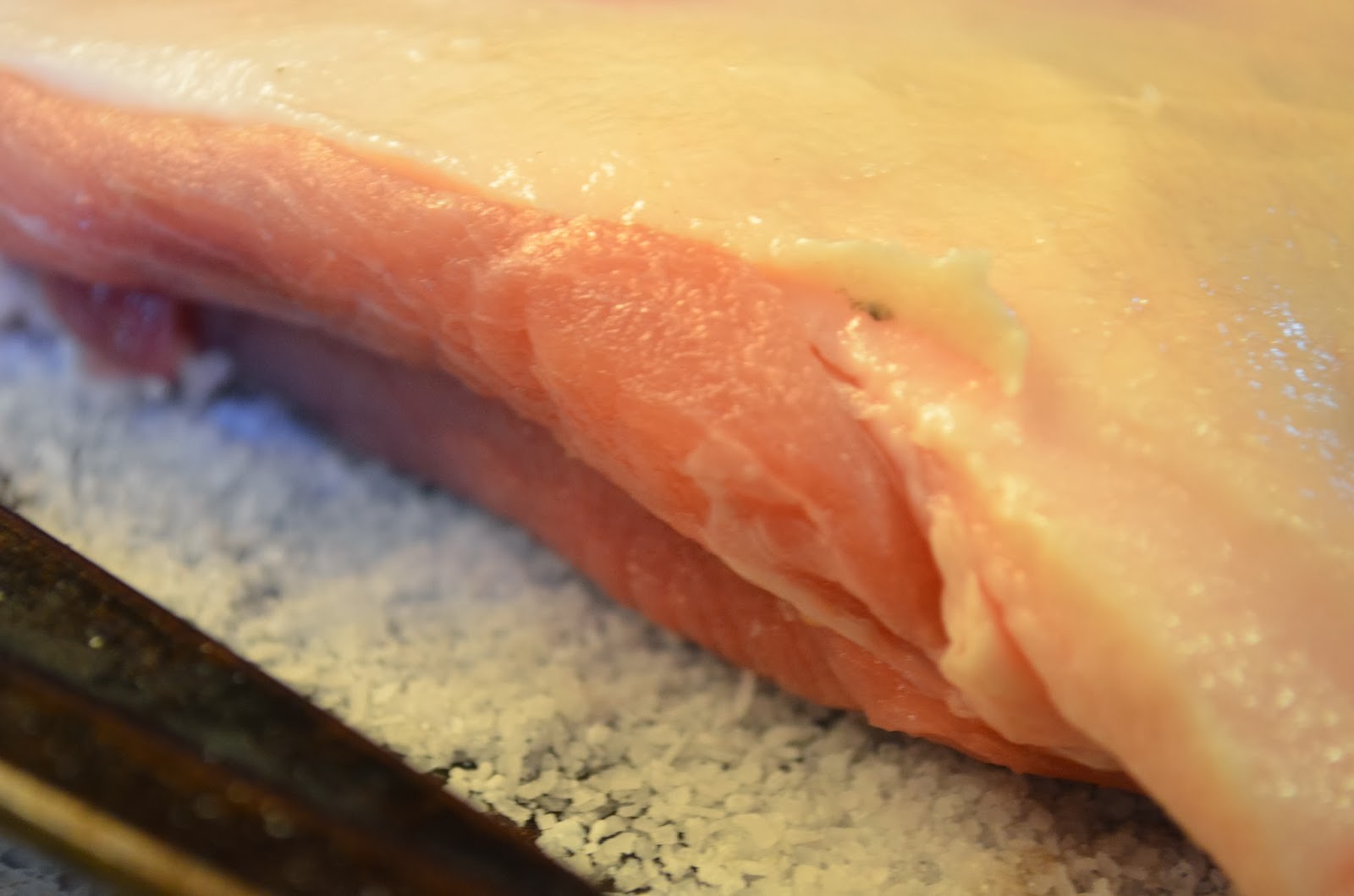
A couple of months ago for our Tastebuds dinner club as part of a deep south theme and did braised pork belly. We had about half of the meat leftover and were trying to decide what to do with it. When you have six pounds of pork belly, well what else can you do? We decided to roll up our sleeves and dabble in home curing. We are making pancetta! Oh yes we are!
It is a multi-step process and we began with removing the skin, and packing the meat completely in a salt mixture. Once it was thoroughly coated, we rubbed in a spice mix.
Once we finished this we wrapped it in plastic wrap and pressed it between two weighted cookie sheets on the bottom shelf of the fridge. We will have to flip it daily for a week.
As with many things we try, this process has been surprisingly easy. Once the week is up we will rinse it off completely, then roll it very tightly in cheese cloth and hang it in the root cellar to finish curing. That process will take anywhere from a few weeks to a few months depending on what flavors we are seeking out. Just another Saturday around the farm!
**As an interesting aside: this cut of meat would be called a flap. The same cut that we have been discussing in our Blog Camp Goes to MIT class.
Friday, September 20, 2013
Food As Totems and Power
I am coupling the next two readings in my Blog Camp Goes to MIT class. The topics involved a continuation of the paradoxes and dilemmas that we began last week, and next weeks food and power. I know that preparing for the wedding that we are hosting on the farm next weekend, will take my focus away from next weeks reading, so I did it a little early.
The bulk of the reading on paradoxes came from Cheap Meat: Flap Food Nations In the Pacific Islands. I had very mixed feelings about this book. The authors both redundancies and justifications quickly became tiresome. I was however introduced to the meat flap industry and how these cheap meats are sold off to make sure every ounce of profit can be gained from a pieced out carcass. They are cheap enough that most of the impoverished islanders, not only buy them, but have had them so ingrained in their eating culture, they enjoy and depend on them. This in great part results in the terrible obesity problems of the area, specifically the people of Papua New Guinea that were a focus of this book. The information was dense with much detail about the processors and the traders.
One concept that really stuck with me was the thought of food as totems. "The fact that some eat flaps and others avoid them is recognized not just as a reflection of personal preference (as, perhaps, with eating or avoiding broccoli) but as a mark of group membership. Simply put, flap eaters are seen as distinguished in important ways from refusers. In this regard, flaps operate much as do 'totems'." and "Totems are potent objects, often animals or plants, that serve to define groups and identities---both in and out of themselves and in contrast to those of others." Food is more than just nutrition, it is an identifier of status, tribe, culture, and power.
When looking at the chapter from Sidney W. Mintz's book Tasting Food, Tasting Freedom she speaks a lot about the "inside meaning" versus the "outside meaning" of power. The inside meaning is what it means to the people who are consuming, while the outside meaning is what meaning is taken by those in control. I think this was best illustrated when discussing the military during World War II. What better venue to show this than large volumes of soldiers who are regimented to when, where, and what they eat. I found it especially interesting that these soldiers, coming off of the Great Depression, were now in a situation where they were not only getting three square meals a day, but they were served meat 21 times a week! "They were also given vast quantities of coffee and sweets of all sorts; there were sugar bowls on every table, and twice a day, without fail, the meal ended with dessert. They ate what they were given; what they were given was decided by power holders who functioned outside the army and outside their direct experience." Power. Just as the soldiers during the war experienced power with their food, those stateside had their own experience through rationing.
Through all of this, one company grew dramatically, the Southern based Coca-Cola Company. Soldiers were not given soda, but it was readily available to purchase. A General Marshall, in order to keep a supply of Coca-Cola available at the front, "gave Coca-Cola the same status in the wartime economy as that occupied by food and munitions. Coca-Cola was thus spared sugar rationing. In all, sixty-four Coca-Cola plants were established in allied theaters of war." Now talk about not only power, but establishing a culture, a headline, a totem. Soda become more main stream versus a periodic treat. Now we have generations of soda drinkers, further exacerbating our addiction to sugar, and now the even worse for us sugar substitutes. Quick poll, how many of you when looking for cola, ask for a Coke? It is a totem.
Another example of this idea of power can hearken back to the people of Papua New Guinea. Brisket was popular to be ground as hamburger in first world nations. There was a call for concern about nodules that were found in the meat. "This left Australian meat processors with a great volume of low-value beef clogging their freezers." So it was thus introduced to the pacific islanders who developed a taste for it. "once nodules were no longer declared a health hazard, the brisket trade immediately shifted back to North America. Significantly, we were told, the sudden withdrawal of brisket left Papua New Guinea with 'a big, gaping desire'." enter meat flaps. Does not this whole debacle wreak of food being used as power? It was given, then taken away, leaving those in it's stead with a craving that was ultimately to be satisfied with an even cheaper, less healthy, substitute.
Interesting to look at the influencers isn't it? I look forward to learning more about the industrialization of food and then moving into culturally authentic food. How do we put all of these pieces together to form where we are today? More importantly, we can better understand where we are headed, and what we can do to make positive change.
Friday, September 6, 2013
Random Five Friday
This week has just flown by, with the holiday Monday, school and fall sports in full gear, I can honestly say that I do not know where the week went....but I am happy that it is Friday!
1. We have one of B's veterinary school roommates staying with us this week. He is in town for a certification class. It has been about six years since we saw him last, so it has been fun!
2. B attempted an eradication of the troublesome ground wasp nest late last night. Several of the extension services recommend pouring soapy water into the nest as a natural way to rid yourself of them. It was both amazing and a little intimidating that the seemingly small area easily took up 18 gallons of soapy water last night. Yikes! We will see what today brings!
3. School began Tuesday for Charles. Last night he came home and informed me that he wants to join band this year. He has never expressed any interest in the instrument opportunities that he has had in the past so I am excited for his enthusiasm. His instrument of choice....the oboe! I asked him why and he said that it just sounds awesome....and he could blow the longest into it! He did make me aware that I had to be very careful of the mouth piece....because if I broke the reed it would cost $30 to replace. I can not wait to see him tackle this new challenge!
4. I wrote my second assignment for our Blog Camp goes to MIT class. It has been a really great feeling to be 'back in school' again. It is amazing how immediately reminiscent it felt while reading the assignment and then converting my thoughts into a mini term paper.
5. After several months on the programs committee for the Eco-Justice Center, I was invited to apply for a board seat. Yesterday afternoon, myself and a friend of mine were both oriented on our responsibilities. A new adventure beginning.
Linking up with:
Monday, September 2, 2013
Paradoxes & Dilemmas
This weeks Blog Camp Goes to MIT assignment involved four readings all with the question what are our food dilemmas now? Interestingly, the readings spanned a great deal of time, from 1942 through as current as 2011. These writings can be broken into say three food groups;
- diets- fads and why we are so susceptible
- production- a trichotomy between mass production, crop manipulation, and hunger
- culture- the significance of food through time and how it is viewed
Let's start with the first 'food group' ~ diets. In Michael Pollan's article dated October 17, 2004 titled Our National Eating Disorder printed in the NY Times, he discusses multiple thoughts regarding diet over time. He begins the article and weaves throughout reflections on the almost knee-jerk reaction that people have when accepting and trying each and every new 'fad diet' out there. At the time this article was written, it was the height of low/no-carb dieting. But there are mentions of other doctor or dietitian recommended eating methods, and basically "Americans will get behind any diet as long as it doesn't involve eating less food." That is truly and honestly it. In this super-sized, fast, pre-packaged society that we live in it is far too easy to take the path of least resistance...especially if it is advertised as wholesome. In order to produce the most for the least our crops have been bred, fertilized, and insect repelled so much that the nutrition has been almost completely stripped from them. But hey, that is a-OK, because when these raw materials are processed, they are 'fortified' with things to reintroduce some fragment of what we have depleted. Why are we so married to the latest and greatest diet craze? I'll come back to a solution in the third 'food group'.
The second 'food group' I will touch on a bit is production. Margaret Meade's 1970 piece on The Changing Significance of Food, looks in depth at our implementation of mass production and how that made it easy for us to manufacture "on terrifying scale, foods and beverages that were guaranteed not to nourish." Once again seeing that easy and cheap ingredients can make a lot of filler disguised as 'food product' (haven't you seen that phrase on a label before)? As a striking counter balance to this wealth of efficiently used farm land and production capabilities, is the fact that there is still so much hunger all over the world, as well as here at home. "Those who are not fed will die, or in the case of children, be permanently damaged. We must balance our population so that every child that is born can be well fed. We must cherish our land, instead of mine it, so that food produced is first related to those who need it; and we must not despoil the earth, contaminate, and pollute it in the interests of immediate gain." This can in part begin to be accomplished by looking to and finding value in more local agriculture (small family farms) and eating a diet based more on seasonally and locally available foods.
In Mark Bittman's NY Times article A Food Manifesto of the Future, he points out several key areas that can help us begin to re-focus our priorities. "Markets-from super to farmers- should be supported when they open in so-called food deserts and when they focus on real food rather than junk food." During the research for a Co-op grocery store that we are trying to get open in our community, it was found that a large section of our town was considered a food desert. Though it includes a very wide demographic, the inner city is wholly included in it. People having good food choices in close proximity to their homes is vital in building a healthier future. "Encourage home cooking. (Bittman says), When people cook their own food, they make better choices. When families eat together they're more stable. We should provide food education to children." It is shocking how many children can not identify a raw vegetable!
I know that there is a major complaint out there that produce from the farmers market is not financially feasible for many families. What we have been learning since we began this journey is to look. There are many amazing foods available at very inexpensive prices. Buy in the season and put it away. If canning is too expensive (equipment is an initial investment), most things can very effectively be blanched and frozen. As an example, we bought 3 dozen ears of sweet corn from the farmers market yesterday for $7.95. This netted us 20 pts. of corn at 39 cents for 16 oz. A typical can of corn is 12.5-15 oz. This is a tremendous value for something that tastes astonishingly better than what you can buy at the store....for more money. What did we invest? An hour or so of family time to get it done...not a hardship.
Our third 'food group' is one of the most important. It involves the culture of our food, how we eat and the importance we place on eating. Michael Pollan discusses the "French paradox". This is a fascinating concept to me and over the last year I have read a great deal on the subject. As I discussed here and here a defined food environment is where eating is about taste, savoring, enjoyment, and mostly family and friends. Portions are controlled, food is eaten slowly, snacking with the exception of the goûter (what we call linner..the little meal between lunch and dinner) is taboo, and kids are exposed to a variety of foods and expected to eat what they are served. As an experiment, we introduced the concept to the goûter last year and the kids were excited for it every day. This summer I let it slide a bit, and one of the first things that I heard the kids discussing with the return of school was that they would get their linner back. Hmmm, feeling a little guilty here, but I am thrilled that it made such an impact. They eat their meals better and without complaining, and they do not snack in between (so they are hungry for their meal). Though we in the US have regional specialties and dishes, we have no defined food culture, no standards for the importance of the meal and how food is to be enjoyed over conversation and not just inhaled without tasting, so we can move onto the next event.
As you can see from this not so brief dissertation, that there are many dilemmas when it comes to food. I have not resolved any of them here, just pointed out some of my ongoing concerns. If we want to reverse the growing trend of shorter life-spans and earlier onset of disease, we should look closely at what and how we consume that stuff that sustains us, and maybe aspire to do it more thoughtfully.
Subscribe to:
Posts (Atom)
-
Simple Things is a periodic post inspired by Christina. It always seems to come at an important time for me too. In the midst of our long wi...
-
Though our weather is winter coats one day and t-shirts the next, the longer days have made the early garden very happy. One of the bab...
-
#tbt Circa September 2004 & July 2008. These two have been buds since Mia was 2 and Sidney 6 months old. Yesterday Mia gradu...