Showing posts with label beekeeping. Show all posts

Friday, August 14, 2015

How Two Hives Become One


Two years ago, B placed two bait hives in different trees around the property.  There they have sat since, unsuccessful at catching a swarm.  I talked about our honey tree here, and it has been a very active hive with an enormous number of bees.  Low and behold, as we were surveying the place a week or so ago, B discovered that one of the bait hives was full of bees!  We are certain that the abundant honey tree hive, must have recently swarmed, and they did not travel too far.  Now comes the dilemma, they have built a fair amount of comb already, but there simply is not enough time for them to make a home to sustain themselves through the winter.  So on the advise of a bee keeping friend of ours, we decided to introduce this box to our other large hive and see if we could get them to assimilate.


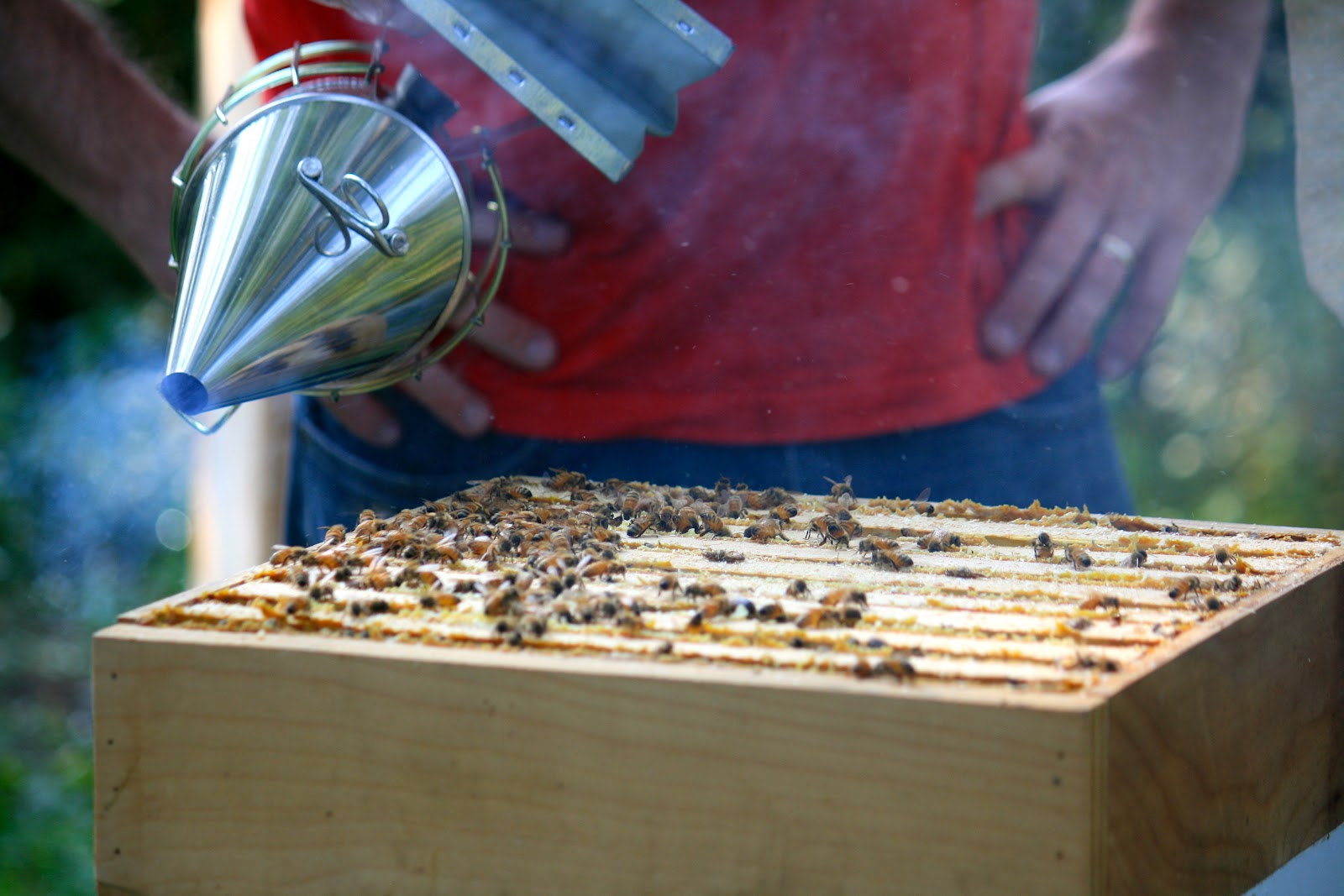
When working with bees, B has found it is best to have all of your ducks in a row supplies wise before you don the very warm bee suit on a hot humid day.  Fortunately, last Sunday was a perfect morning for the move.  It was foggy and a bit cooler, so there was not much in the way of activity around the hives early in the day.  First, he smoked both hives to encourage the bees to ascend into the upper portions of their respective hives.  


Then, he detached the bait hive from it's foundation in the tree, put a bottom platform on it, and blocked the exit door so they could not all fly out while being moved.  The idea when combining both hives is that when we add the new hive to the bottom of the existing one, top it with a large piece of newspaper like paper with some slits cut in it.  Over the next several days the bees will eat through the paper and be released into the existing hive, hopefully giving them time to recognize each others scents and adjust.  Then what will come is the queens deciding who will reign.   


The bottom box on the main hive was empty, but the bees were just beginning to beard into it preparing to fill it, so the timing was perfect to remove the empty box and add the new hive with the partially completed box.  The whole process took about 30 minutes, and now we wait to see if it is successful.  After about 48 hours, we were advised to open the exit door on the bottom hive, and when B did there was a huge flurry of activity.  It will be interesting to see if they assimilate.

Thursday, June 4, 2015

Honey Tree


Our bee hive began to be very active in very early spring, even on fairly cool days.  As a result, B supered (added a box to the top full of pure comb just to be filled with honey) the hive a month ago.  The week before Memorial Day was warm and the hive was increasingly active, and B had spotted some queen cells inside so we were concerned that they were preparing to swarm, but as we were headed out of town we left it to nature.  The hive is still full of bees, but Monday, B felt pretty confident that there had been swarm, and we figured c'est la vie since we had been gone.

Yesterday as the kids were spending some time outside, they came running in, did you know there are tons of bees in the tree with the mushroom in it?  Sure enough it appears that our swarm has found a new home inside of this tree.  I am happy they decided to stick around and pollinate our garden.  We may not be able to get any honey from this group, but it is pretty cool that we'll have a honey tree.....where's Pooh?

Saturday, January 24, 2015

A Sweet January Thaw


Though I enjoy the cocooning in of winter time, I have to admit that the forty degree temperatures and sunshine today were welcome.  It felt somewhat like early spring, with that itching to walk the property, begin farm projects, and throw the windows open (at least for a short time), all of which we did.


We cleaned up the chicken coop, began curing 17 pounds of pork, and decided to more thoroughly inspect the hives.  We have one hive going gang busters and we fed it with a generous amount of fondant to sate it until the nectar flow.  Sadly, our other two hives were dead.  They were honey bound, we had a very late nectar flow last year and they were storing honey until quite late, with not enough time to get it to the appropriate location so that they would have enough space to winter over.


We had not collected honey in 2013 or 2014.  In 2013 we wanted to leave the honey stores to them for feeding through winter, and were thankful we had.  Despite the polar vortices's, they all survived because of the honey stores to their spring feeding.  We had hoped for a similar result this season, but that was not entirely the case, therefore we have had an unexpected January honey harvest this weekend which yielded 25 lbs of the lightest, most beautiful honey from the first hive, and the second and somewhat larger hive is straining now.  A lovely gift from our hard working pollinators.

Thursday, February 20, 2014

Don't Eat Yellow Snow


Yesterday was the day we had been waiting for for over a week.  It was going to be warm enough that we could crack open the hives and take a peak.  We went out during lunch to begin to assess the situation.  To our excitement as we neared the hives, after trudging through knee deep snow, there was tons of activity.  Our two main hives seem to have maintained astonishingly large numbers through the winter.  Sadly our two smaller hives never became large enough to sustain themselves in the dramatic temperatures that we have had. 


They had two main activities yesterday as you can see from this photo, one was cleaning house.  They began to discard the dead bees from the hive.


The other, and arguably more important activity was getting out to poop!  Poor things.  It has been too consistently cold for them to get out and relieve themselves.  If you notice in the photos above, the snow is littered with little amber spots.  This my friends is bee poop.  You could sense their exuberance at the relief!


As we were checking each hive, they were all around us saying hi and it was as good a boost as the warm 42 degrees to our attitudes.


It appears that there is still some honey left for them to eat, but we also have ordered some fondant to supplement their feeding through the rest of the winter.  I ran to the store in the afternoon to pick up some pine shavings to replace what was in the quilt.  After B got home from work it was just twilight and we ran out to get that task done.  I wish that I had my camera with me, of course in my haste to get out before we lost the light, I forgot it in the house.  I can assure you it was a sight to see.  Aside from the little dots littering the snow for 50 feet around, a three foot circumference around the hive was completely saturated with amber.  I was going to try to catch it this morning, but the freezing rain started about 4 am and by the time it was light enough, snowball sized snowflakes were falling.  The sight around the hives gave completely new meaning to the old phrase 'don't eat yellow snow!'

Thursday, June 13, 2013

What a Ride


There is such a delicate balance to nature.  Even with the most conscientious of care, it can be hard to predict which things will thrive, fail, or endure the slimmest of odds.  It can be all at once disheartening and uplifting, and we find that as we nurture different things, we become very connected to them.

Most days we walk the homestead three times, early morning, mid day and evening.  We peruse the garden, check the bees, plan for future crops or animals, let the chickens out into the yard, harvest, water, pet the bunnies, weed pull, dream, and simply enjoy.

There are ups and downs to this process, because we will notice even slight changes that lead us to investigate and sometimes worry.  Both of our bee hives have been vigorous all spring, so much so that we had to add an additional box to each of them.  This week we had slowly warming weather, then a sudden very warm day.  I noticed that one of our hives had a large number of bees congregating outside, and some beginning to beard there.  This sent me into a little bit of a panic.  Are they going to swarm?  Are they unhappy in their home?  Are they just too warm from this crazy weather and getting some air?  We watched them carefully over the last couple of days and they are hanging in there.  This morning B noticed that the other hive seems to have many fewer bees, and we wonder whether this hive swarmed.  This second hive though robust,  has not been nearly as active as the other.  Maybe it lost its queen, and they are in the process of making a new queen.   It could be the other just had a huge brood hatch and by comparison it looks much more populous.  It looks like we will be examining the boxes in more depth to see if we can see a problem, or detect a new queen cell. So many possibilities, one of which is hives sometimes just swarm, period.  We will be setting out our bait hives this weekend, hopefully looking to catch a wild swarm, and not one of our own!

There is something about relying on mother nature that is very rewarding and humbling.  Hard work can be rewarded or punished by such simple things when you are relying on the elements and ecosystem around you.  But wow, what a ride!

 **Update.  After I posted this B spoke with our bee keeper friend who is very seasoned and been doing this for many years.  It seems we anticipated everything right, and it would be unusual for one warm day to cause a sudden swarm, especially since this hive was not the one with the excess of bees.  He thinks it sounds more like a mass die off due to some contamination/poison.  It happens these days.  We will inspect the hive this weekend to see if there is still a queen, and if the numbers continue to die off.  It leaves me sad, this was not necessarily mother nature, it was man made.  Big Ag may have created crops and insecticides to increase yields, and make for cheap hybrids (where the nutrition has all but been removed; ie. today's grains).  But I wonder what the true cost will be?  We already see effects in the health of the natural ecology.   The long term health effects to humans is yet to be seen, though I think he tip of the iceberg is emerging.

Monday, September 17, 2012

Harvesting Honey ~ Part One


The weekend was absolutely beautiful.  We were able to spend some time in the garden and preserving food.  Late last week, as we would go in and out of the garden, we were welcomed by a fragrant odor.  Honey!  Yes, depending on the wind direction, we could actually smell the hives!  Such a cool thing.  Then, upon one of our evening inspections of them we noticed that the hives were kicking out the drones, a sure sign of these busy bees' winter preparations.  We decided it was time to harvest the largest hive, and check the wild swarm to see if we could harvest the half starter box we put them in with in July.


So we started small.  First, B checked to see if there was any comb in the bottom box of the smaller hive.  There was comb in that box and a mixture of brood and capped honey in the box above, with a full box of honey to feed them for the winter, we were set to harvest the half sized box on top. 


We used liberal amounts of smoke, and overall, the bees were very calm during the whole process. 


When separating the two boxes there was some extra comb that pulled apart.  B has heard that using something like a piano wire to slide between the two boxes before removing will minimize this effect.  Something for us to try next time.


So we set the harvested boxes of honey aside so that the remaining bees in the boxes could find their way home.  The disruption sent many bees to the hive entrances to fan, so that those separated could return.


B then removed the chunks of cone that came apart and put them into a bowl.  This little bit of comb gave us about 1/2 a bottle of honey in addition to tons to snack on the rest of the evening with all the kids.


This is a shot of the half box.  We put the two boxes into a large Tupperware container overnight, weighted down, but with an escape route for the bees.  This morning, we moved that Tupperware to a shaded area of our porch and hopefully the remaining bees will vacate during the day today.


We have ordered what we need to complete extracting the honey from the comb, so that will be a task in the next week or so.  We estimate about 30 pounds of honey.  Not too bad from a first season, and with only 1 1/2 boxes harvested!  The third hive, we left alone.  We added a new queen to it about 6 weeks ago and there is now active brood.  They have one box full of honey but have not yet ventured into the second box.  We will leave them to regenerate their numbers and will hopefully start the spring with three hives, two of which will most likely need to be split!